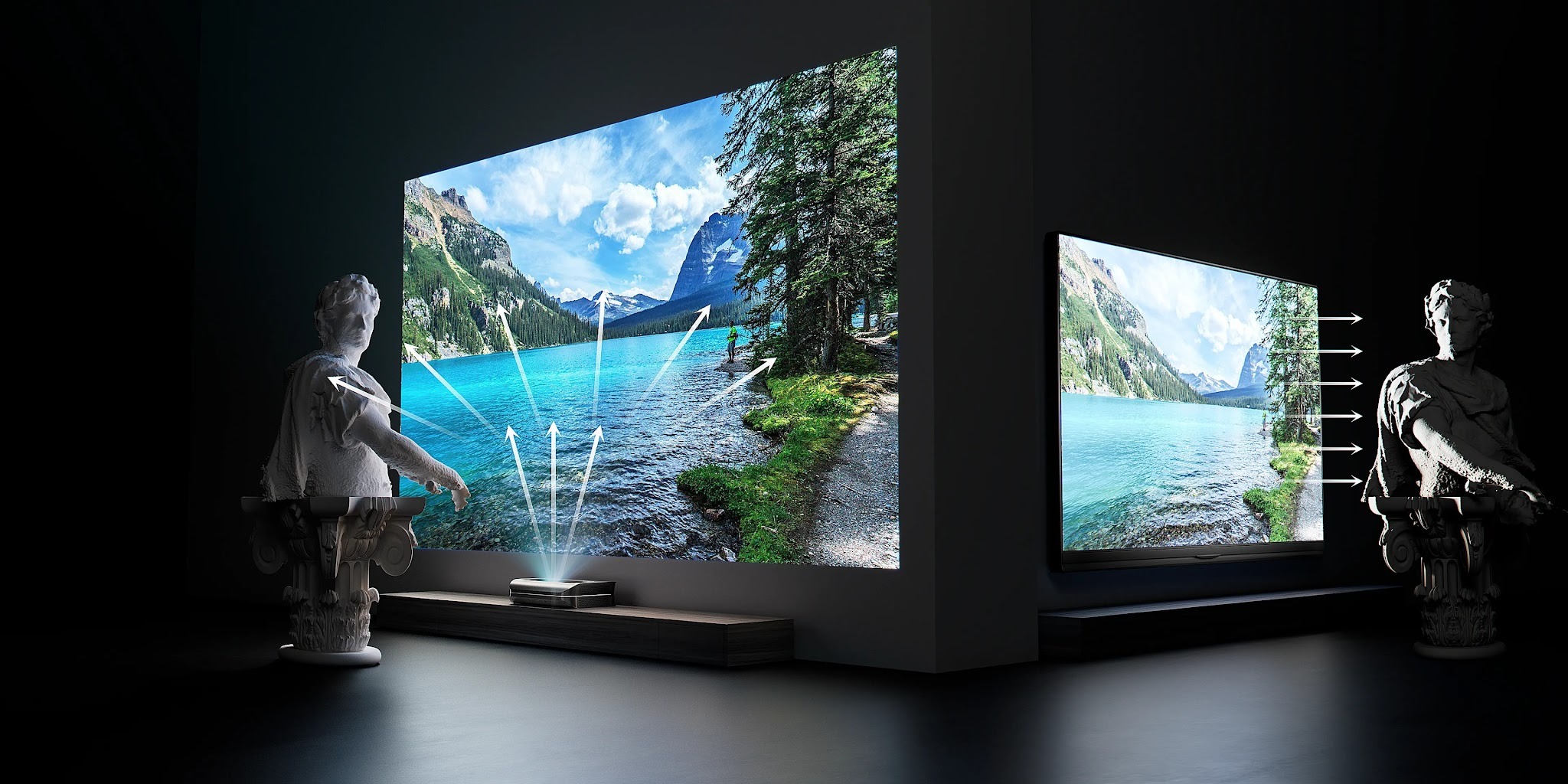
As our lives become increasingly digitized, families are more conscious than ever about the physical effects of screen time. We buy blue-light-blocking glasses for our home offices, set daily app limits on our children’s tablets, and diligently switch our smartphones to “night mode” after dark. Yet, at the end of the day, many of us gather in the living room and stare directly into a massive, 75-inch pane of light-emitting glass for hours on end.
While we often worry about how much time we spend looking at screens, we rarely pause to consider how those screens deliver light to our eyes. From a physiological standpoint, not all displays are created equal. If you are looking to build a healthier, more comfortable entertainment space for your family, it is time to understand the critical difference between emitted light and reflected light.
The Physical Toll of Emitted Light
To understand why our eyes feel so tired after a long movie marathon or gaming session, we have to look at the mechanics of traditional flat-panel televisions. Whether it is a standard LED, QLED, or OLED, traditional TVs function by emitting light directly from the hardware into your eyes.
This direct light emission is fundamentally unnatural to human biology. When you stare at a television, your retinas are being bombarded by a concentrated, focused beam of artificial light. This constant exposure forces the ciliary muscles in your eyes to work overtime to manage the light intake. Over time, this leads to a common condition known as Digital Eye Strain (DES), or Computer Vision Syndrome. Symptoms include dry eyes, blurred vision, tension headaches, and a general feeling of visual fatigue.
Furthermore, traditional flat panels emit significant levels of high-energy visible (HEV) blue light. When this direct blue light hits your retina, particularly in the evening, it suppresses the body’s natural production of melatonin. This biological disruption tricks your brain into thinking it is still daytime, leading to restless nights and altered circadian rhythms for both adults and children.
The Natural Biology of Reflected Light
Our eyes did not evolve to stare into direct light sources. Looking directly at the sun or a bright flashlight is instinctively painful. Instead, human vision evolved to process reflected light. We see the world because light from a source (like the sun or a lamp) bounces off an object (like a tree or a book) and is naturally diffused before it reaches our retinas.
Projection technology is the only home entertainment medium that mimics this natural biological process. When you use a projection system, the actual light source is pointed away from you. The light travels to a surface, bounces off, diffuses, and then gently returns to your eyes.
Because the light is scattered and softened upon reflection, the sheer intensity of the light energy hitting your cornea is drastically reduced. Your eye muscles do not have to clench to filter out the glare, resulting in a much more relaxed, comfortable viewing experience.
Upgrading the Living Room with Laser Optics
In the past, families might have hesitated to switch to projectors due to concerns about image brightness or the hassle of ceiling mounts. However, the introduction of ultra-short throw technology has completely modernized the wellness-focused living room.
Swapping a giant, light-emitting television for a modern 4k laser projector offers a massive physiological advantage. These sleek devices sit directly below the viewing surface, safely bouncing brilliant, high-definition images off the wall. You still get the vibrant colors, the razor-sharp 4K resolution, and the brightness needed for daytime viewing, but the delivery mechanism is fundamentally safer for long-term eye health. It provides the scale of a cinema without the harsh, direct blast of artificial blue light associated with giant LED panels.
The Crucial Role of the Diffusion Surface
However, there is a catch: the health benefits of reflected light are entirely dependent on the surface doing the reflecting. Bouncing a powerful laser projector off a glossy painted wall or an uneven surface can create “hot spots”—concentrated areas of glare that completely defeat the purpose of using reflected light in the first place.
To ensure your eyes are actually receiving smoothly diffused light, the image must be projected onto an engineered surface. Pairing your hardware with a high-quality projector screen is vital for eye comfort. Modern Ambient Light Rejecting (ALR) screens are designed with microscopic structures that evenly distribute the projected light across the entire viewing angle while absorbing harsh ambient light from overhead fixtures. This eliminates glare, prevents eye-straining hot spots, and ensures the image remains crisp and gentle on the eyes from anywhere in the room.
Bigger Screens, Less Strain
There is one final, counter-intuitive benefit to projection: bigger is actually better for your eyes.
When we look at smaller screens—like tablets, phones, or even mid-sized televisions across a large room—we have a tendency to squint. Our eyes strain to resolve fine details, read on-screen text, or track fast motion. By upgrading to a 100-inch or 120-inch projected image, everything is presented at life-size scale. The eyes do not have to work nearly as hard to focus on the action, which significantly reduces the muscular fatigue associated with prolonged viewing.
In our screen-dominated world, completely eliminating digital entertainment is unrealistic for most families. However, we can choose healthier ways to consume it. By embracing the natural, diffused mechanics of reflected light, we can protect our family’s eye health, improve our sleep hygiene, and finally enjoy movie night without the morning-after headache.